
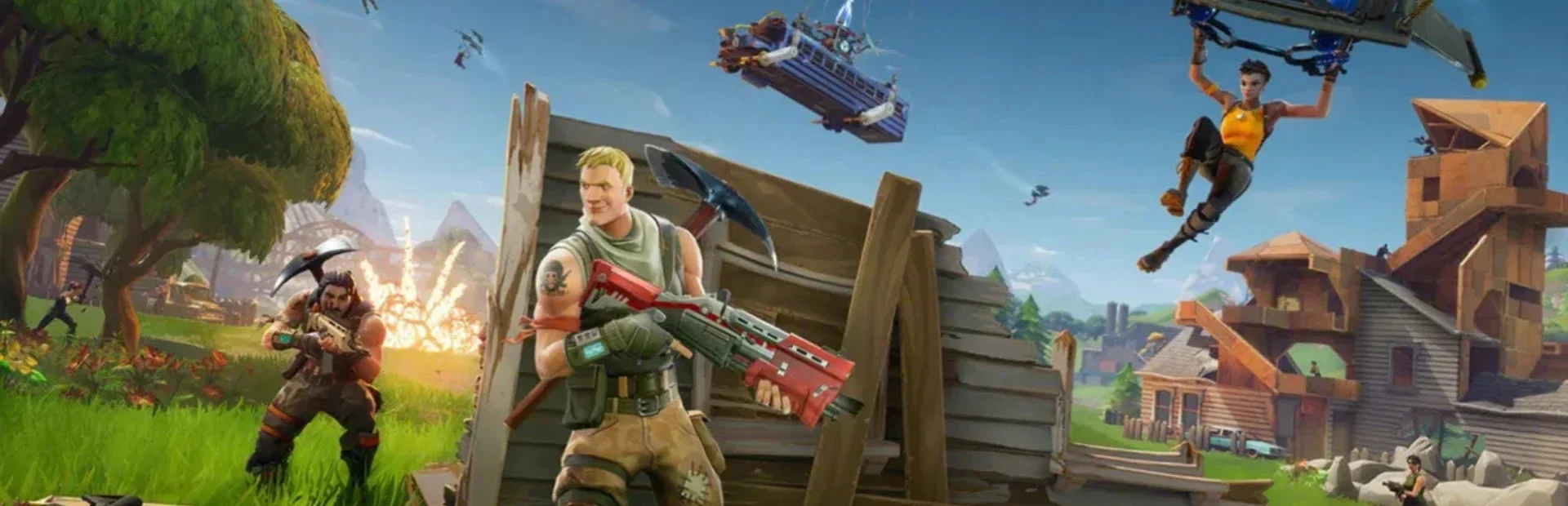
Credit: Fortnite
esportsEsportsfortnite
FNCS 2026 brings Fortnite back to duos as Epic rebuilds the season around more live events
April 28, 2026·5 min read
Epic’s 2026 competitive reset is built around a familiar change with wider consequences. FNCS is back in duos, reversing last year’s trios structure and putting the main circuit around one of Fortnite’s most popular formats again. The shift is not happening on its own. It sits inside a season with more than $10 million in total prizing, a global championship in November, and a calendar that now leans much harder on in-person events.
That broader structure is the real story. Epic is not just changing team size. It is trying to make the 2026 season feel bigger and more international, with four LAN-style headline events now tied to the year: the Major 1 Summit in Germany, the Pro-Am, the Reload Elite Series LAN, and the Global Championship. The result is a circuit that looks less like a long online grind and more like a season punctuated by live stops that can carry their own identity.
Duos returns because Epic is rebuilding the center of competitive Fortnite
The official 2026 FNCS rules make the format change unmistakable. Section 4 of the rules defines the competition around duo teams, and the broader FNCS overview page presents the entire season as a duos road to the championship. That gives 2026 a cleaner competitive shape than a year ago, when Epic had pushed the main circuit into trios.
That matters because duos has always occupied a strong place in Fortnite’s competitive history. It is easier for viewers to follow, easier for players to build chemistry around, and easier for Epic to market as a star-driven format. The game still allows for stacked lobbies and layered strategy, but the spotlight falls more directly on individual pairings than it does in larger team structures.
The qualification structure around that format is still demanding. Epic’s rules require players to meet stricter baseline conditions than a casual event, including account level, tournament participation history, and region lock rules during each Major. So while the return to duos feels familiar, the route through the season is still built to narrow the field quickly and keep the strongest pairings moving toward LAN qualification.
The live-event calendar is what makes this season feel more ambitious
Epic’s official overview shows the three online Majors feeding into a much bigger end-to-end season, but the first clear marker of that ambition is the FNCS Major 1 Summit. Epic says the event will bring 100 players to Düsseldorf on May 30 and 31, with a $1 million prize pool and direct Global Championship qualification for the top five duos. That is not a side event. It is one of the season’s real anchor points.
Beyond that first Summit, the 2026 roadmap revealed by Epic last year also included the return of the FNCS Pro-Am, the Reload Elite Series LAN, and the year-ending Global Championship in Europe. Those additions matter because they turn the year into something more layered than a standard online circuit with one final destination at the end. Each event serves a slightly different role, whether that is competitive prestige, crossover appeal, or mode-specific expansion.
The live schedule also helps explain why Epic went back to duos now. A season with several LAN stages benefits from a format that is easy to package, easy to follow, and built around recognizable pairings. Duos gives the circuit that in a way larger team formats often do not.
The new Mobile Series shows Epic still wants more than one path into the ecosystem
One of the more important additions in the 2026 roadmap is the $1 million Mobile Series. Epic’s competitive surfaces already list Mobile Series sessions on the schedule, which shows the company is not treating mobile competition as an abstract future plan. It is part of the active 2026 calendar.
That matters because Fortnite’s competitive structure has often struggled with how broad it wants to be. The main FNCS circuit is the prestige product, but Epic also wants more ways for different player groups to enter the system. A dedicated Mobile Series gives the company a separate competitive lane without forcing those players to fit entirely into the same path as the core FNCS field.
It also fits the wider shape of the 2026 season. Epic is not only trying to make FNCS bigger. It is trying to make Fortnite competitive feel more varied, with different event types, different entry points, and more reasons for the calendar to stay active between the biggest championship moments.
Epic is turning 2026 into a fuller season, not just a format reset
That is the clearest way to read the announcement. The return to duos is the headline because it is the simplest change to understand, but it is not the only one that matters. Epic has paired that reset with a more event-heavy calendar, a stronger LAN presence, and a mobile track that broadens the competitive picture around FNCS instead of sitting outside it.
If the structure works, 2026 will look less like a correction and more like a new model for what Fortnite esports is supposed to be. The duos format brings the center back into focus. The LANs and the Mobile Series are what make the rest of the year feel larger.
Fortnite
Xbox Series X|SPlayStation 4Nintendo Switch 2
Released
June 29, 2020
Developer
Epic Games
Publisher
Epic Games
Systems
Xbox Series X|S
PlayStation 4
Nintendo Switch 2
Android
PC (Microsoft Windows)
iOS
PlayStation 5
Mac
Xbox One
Nintendo Switch
Tagged In
esportscompetitivefortniteepic gamesbattle royalefncs