Ōkami at 20: Its Beauty Has Aged Better Than Its Pacing
Clover Studio's ink-wash adventure remains visually and mechanically distinctive two decades later, even as its long explanations, false endings, and repeated structure reveal the habits of another era.
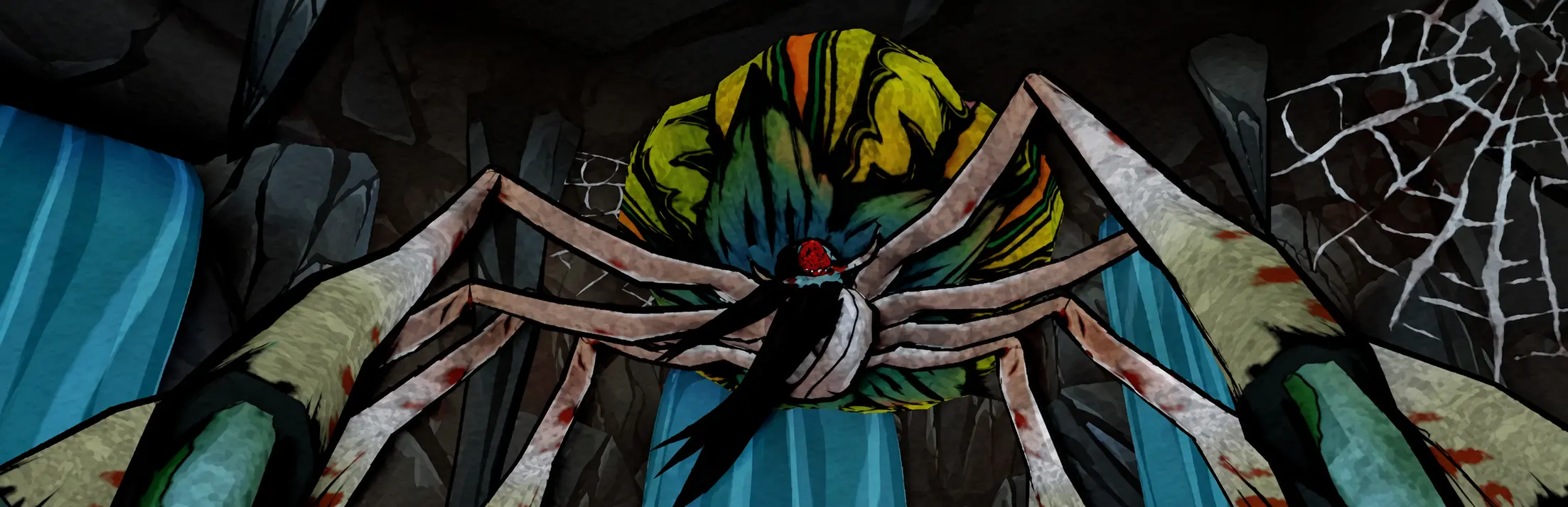
A cursed landscape in Ōkami does not simply become safe again. Ink-dark ground turns green, flowers race across the fields, trees burst into bloom, and the music rises with them. The transformation lasts only a few seconds, but it contains the whole game: nature is not background decoration, and restoration is not an abstract objective. Both are meant to be seen, heard, and performed.
Twenty years later, those sequences have lost almost none of their force. Higher resolutions have preserved Ōkami's surfaces, while its art direction has protected it from looking like a technical relic. The adventure has not aged as cleanly. Ōkami still knows how to fill a world with life, but it is less certain about when to leave that world alone.
A technical compromise became Ōkami's identity
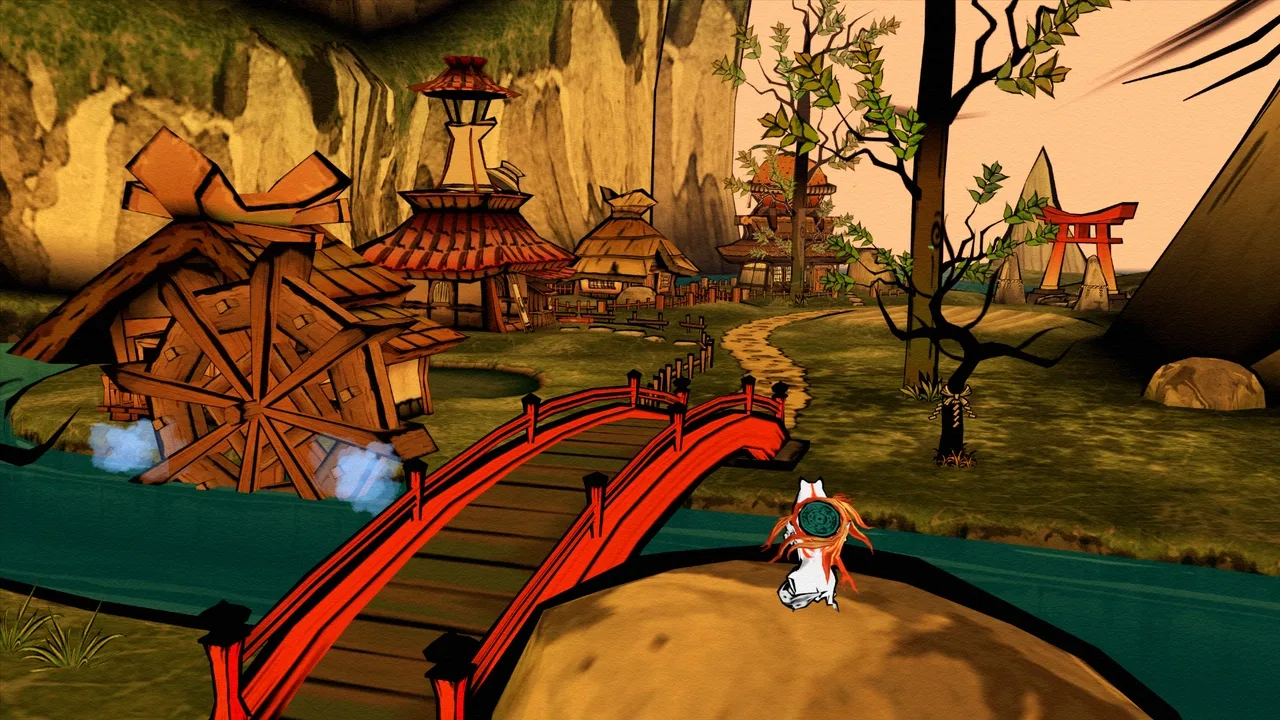
The game began with a different visual ambition. Director Hideki Kamiya wanted to depict the natural beauty of the Japanese countryside with realistic graphics, inspired partly by the GameCube remake of Resident Evil. During development, however, a Japanese-style brush drawing of Amaterasu by character designer Kenichiro Yoshimura helped push Clover Studio away from realism and toward the sumi-e-inspired look that defined the finished game.
That change did more than solve a technical problem on PlayStation 2. Thick outlines, pools of flat color, paper-like texture, and exaggerated characters gave every part of Nippon the same visual grammar. Amaterasu's movement leaves flowers in her wake. Smoke curls like wet ink. Defeated demons collapse into stylized bursts rather than broken bodies.
The HD releases make some simple geometry easier to spot, but added sharpness does not break the illusion. A realistic game from 2006 would inevitably invite comparison with newer models, lighting, and animation. Ōkami asks whether each scene resembles a moving illustration, and the answer remains yes. Its beauty survives because it was designed, not measured.
The Celestial Brush turns style into a verb
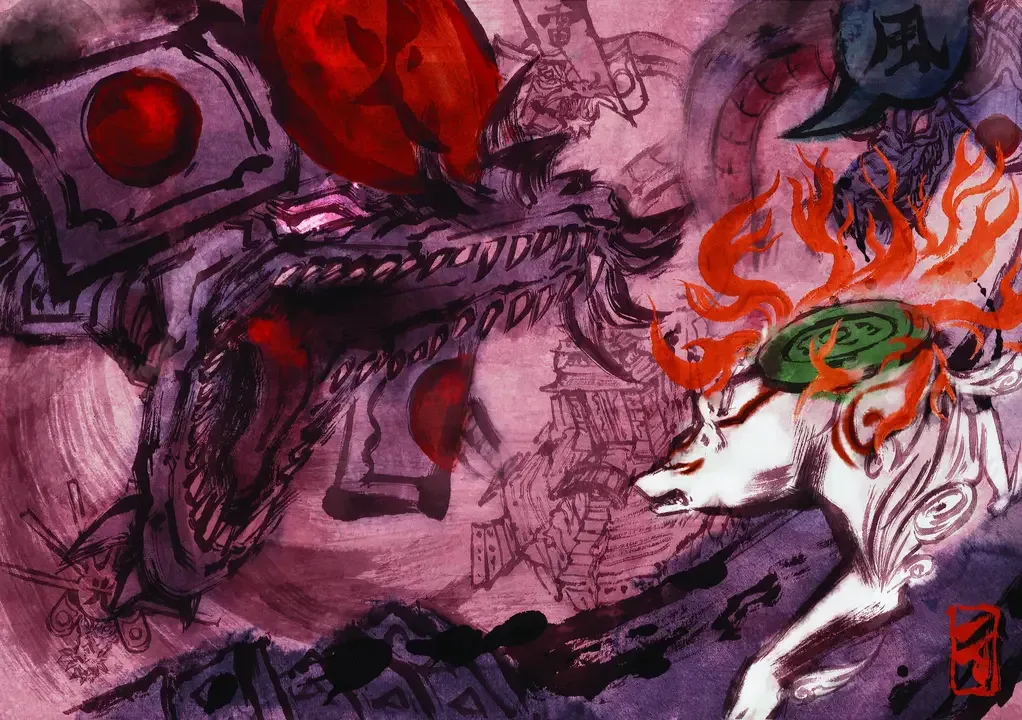
The Celestial Brush is the reason Ōkami's appearance never feels detached from play. Holding a button stops the action and flattens the scene into a page. A line can cut through an enemy or obstacle. A circle can call the sun into the sky. Another stroke can restore a bridge, summon wind, or return blossoms to a dead tree.
Brush recognition can occasionally be fussy, but the underlying idea remains unusually cohesive. Clover did not build an adventure and then wrap it in an ink-wash filter. The player interacts with the world through the same language used to draw it. Art direction, puzzles, combat, and Amaterasu's role as a restoring deity reinforce one another.
That unity gives repeated acts of healing their weight. Reviving a Guardian Sapling triggers another sweeping burst of color, yet the effect rarely feels like a routine unlock animation. The reward is not a larger number or a newly opened icon. It is a place becoming worth exploring.
The adventure reaches its natural ending too early
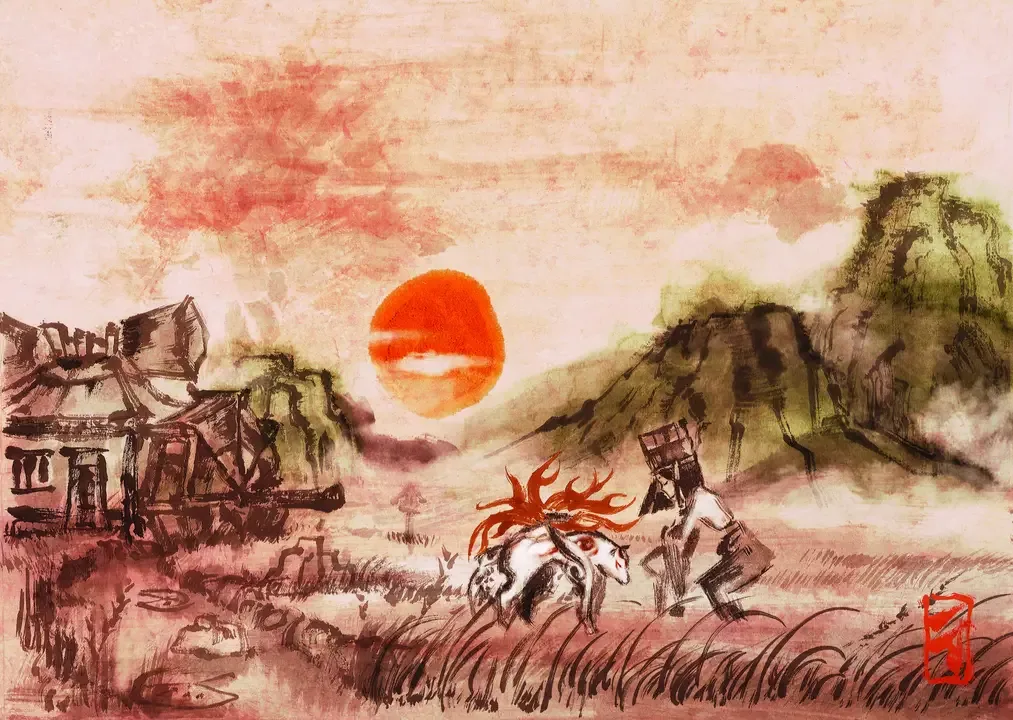
Ōkami's first major campaign is built around a clear promise. Orochi has returned, Kamiki Village is under threat, and the boastful swordsman Susano must grow into the legend everyone needs him to be. The journey through Shinshu Field, Agata Forest, Taka Pass, and the Moon Cave steadily draws those threads together. When that conflict reaches its climax, the game has delivered a complete arc with a villain, a personal transformation, and a celebration that looks and sounds like an ending. It is not the ending.
Amaterasu continues toward Ryoshima Coast, Sei-an City, and eventually the frozen land of Kamui. These later acts contain some of the game's strongest individual ideas, including a haunted ship, a city drained of color, and landscapes shaped by snow and northern folklore. The problem is not a lack of invention. It is that the broader structure has to restart after the first campaign has already spent so much dramatic energy.
Each region tends to follow a familiar sequence. Corruption has spread, local lives have stalled, a new Brush technique must be recovered, and a dungeon leads to the source of the problem. New characters and mythology change the details, but the movement from sickness to restoration becomes predictable. The last stretch then asks the player to defeat several earlier bosses again before the true final confrontation. What could have functioned as a brief farewell instead makes the journey feel even less edited.
Producer Atsushi Inaba described Ōkami before release as an epic assembled from many ideas rather than one central gimmick. That breadth made Nippon feel generous, but it also produced enough material for separate adventures without giving each one a distinct dramatic shape.
Slow exploration works better than forced delay
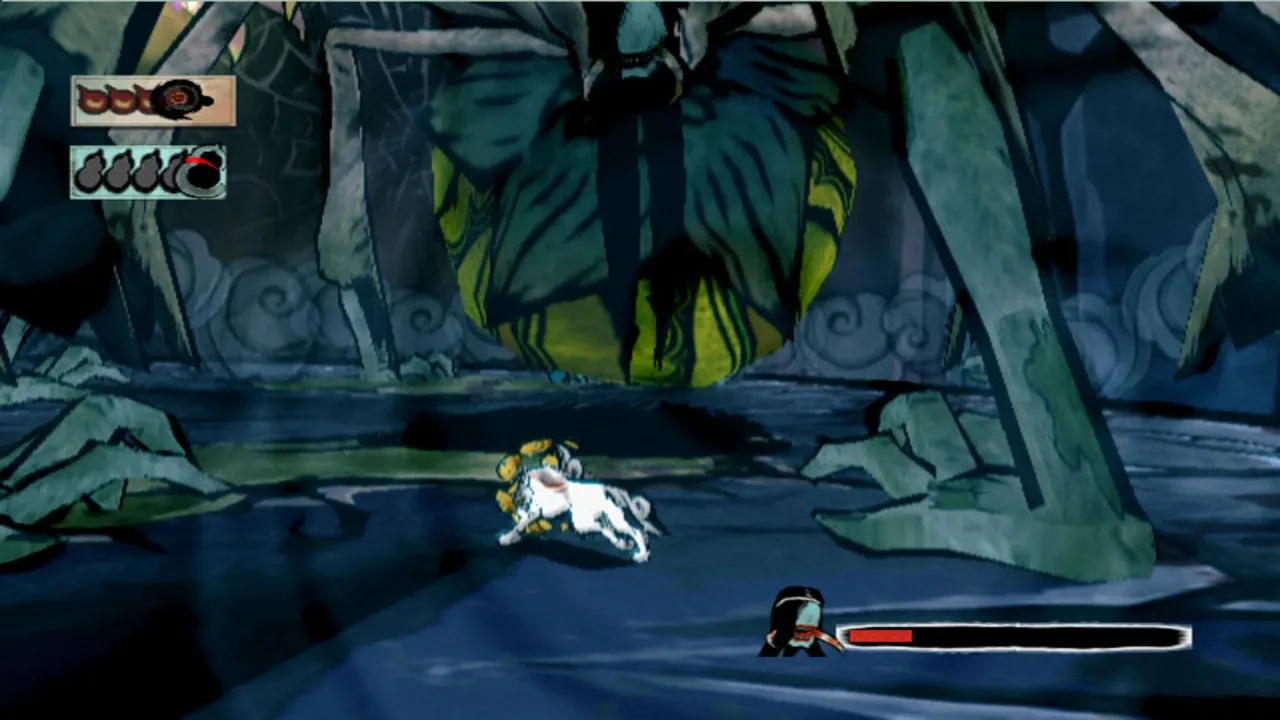
Kamiya said during development that he wanted players to enjoy Ōkami slowly. The game supports that intention beautifully when it lets the player choose the pace. Amaterasu can feed animals, dig for treasure, fish, restore clover patches, help villagers, or simply race across a field while flowers appear beneath her paws. None of these activities needs urgency. Their smallness is part of the appeal.
The weaker pacing comes from moments when the game makes that decision on the player's behalf. Its opening delivers a long account of Orochi and the white wolf Shiranui before control is established. Conversations arrive through slowly presented text and warbling vocal effects. Issun frequently explains a Brush technique, points toward its target, and comments again after it has been used. A system that should encourage observation often reveals its solution before the player can experiment.
This was not criticism invented by modern impatience. Contemporary reviews celebrated the art while also noting the excessive dialogue, forgiving difficulty, and occasional trouble recognizing Brush patterns.
Modern versions allow most cutscenes to be skipped and much of the dialogue to be accelerated, which makes a replay less cumbersome. Those options do not solve the first-playthrough problem. Skipping the delay often means skipping the character writing and folklore that give the journey its personality.
Combat adds another form of drag. Reflectors, rosaries, glaives, and Brush techniques offer expressive combinations, but generous resources and forgiving enemies rarely require mastery. Encounters become sealed arenas that interrupt travel, while many bosses function as visual puzzles rather than demanding tests. Repeating them late leaves little new tension to discover.
The sequel should remember the value of restraint
Ōkami HD remains readily available on PC, PlayStation 4, Xbox One, and Nintendo Switch, giving the original an unusually accessible afterlife for a PlayStation 2 game. It is also no longer a closed chapter. Capcom has an official sequel in development with Kamiya directing at Clovers, supported by M-TWO and Machine Head Works, although no release window has been announced.
The original already provides a precise lesson for that team. Its visual identity became stronger when Clover abandoned realism and committed to a clear limitation. A sequel does not need to repaint that identity with greater detail so much as apply the same confidence to its structure. Give players room to observe before Issun's equivalent supplies an answer. Let regions build different kinds of tension. Allow a climax to remain a climax instead of treating every good idea as material that must fit into one journey.
Ōkami is still beautiful because every stroke appears to belong. Its pacing has aged less gracefully because too few of those strokes were removed. Twenty years on, its final lesson is one of composition: beauty needs room, but it also needs an edge to the canvas.
The Verdict
Ōkami remains a visually distinctive action-adventure whose ink-wash world and Celestial Brush still feel inspired two decades later. Its excessive explanations, repeated regional structure, and late-game boss rematches make the journey longer than its strongest ideas require.
The Good
- +Striking ink-wash art direction that still looks beautiful
- +Celestial Brush connects visuals, puzzles, and combat
- +Memorable world rooted in Japanese mythology
- +Satisfying restoration sequences and varied side activities
The Bad
- -Slow dialogue and excessive explanations disrupt the pacing
- -Repetitive regional structure and boss rematches stretch the story
Ōkami
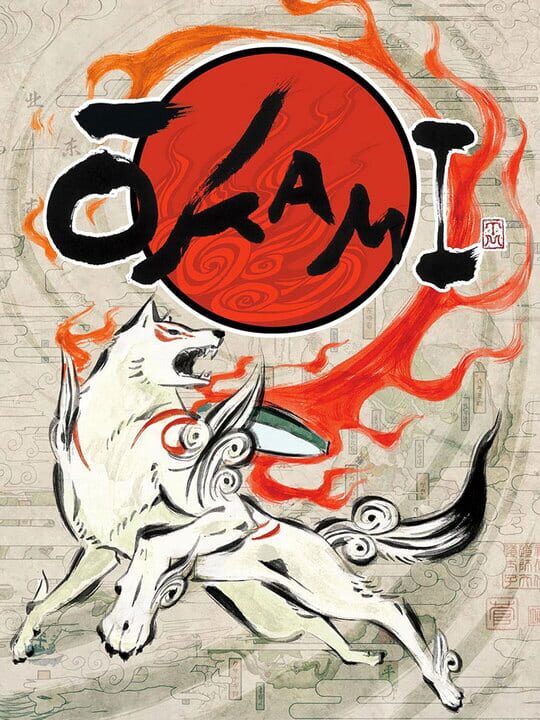
Set sometime in classical Japanese history, Ōkami combines several Japanese mythology and folklore to tell the story of how the land was saved from darkness by the Shinto sun goddess named Amaterasu, who took the form of a white wolf with celestial markings covering its fur. It features a distinct…
Released
April 20, 2006
Developer
Clover Studio
Publisher
Capcom


Tagged In
Discussion
0We want to hear from you. Share your perspective in the comments below, and please keep the conversation respectful.
Log in to join the discussion - vote, reply, and share your take.
Log In