Ubisoft Built an Empire on Open Worlds
Explore Ubisoft’s history, biggest franchises, influential open-world formula, and the restructuring that is shaping the publisher’s future.
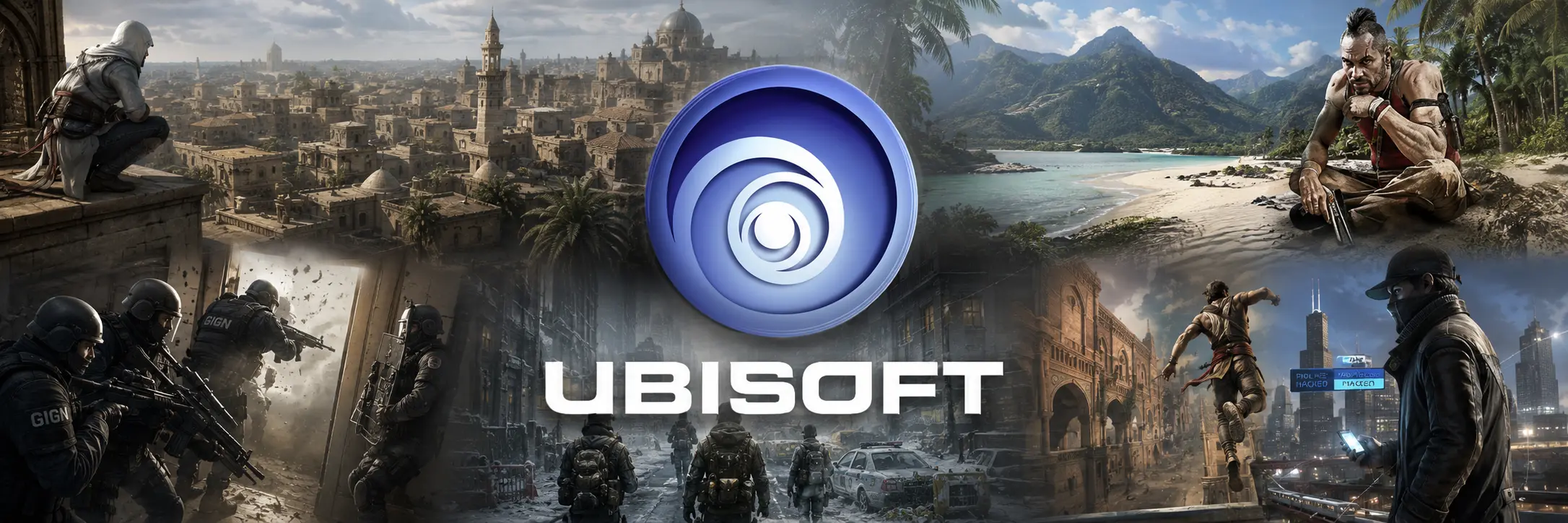
Ubisoft is both a developer and a publisher. The company's biggest games are created within an extensive network of studios that share technology, responsibilities, and experience. This allows the French company to develop projects on a scale that smaller teams would struggle to achieve. Ubisoft is responsible for franchises including Assassin's Creed and Far Cry.
The publisher's scale is both its greatest strength and a source of problems. Ubisoft helped establish the principles of modern open worlds, but it eventually began facing criticism for repeating its own ideas too often. The company's history shows how an effective production model can change an entire industry before forcing its creator to search for a new direction.
Ubisoft Key Facts
- Full name: Ubisoft Entertainment SA
- Founded: 1986
- Founders: Christian, Claude, Gérard, Michel, and Yves Guillemot
- Headquarters: Saint-Mandé, France
- Chief executive officer: Yves Guillemot
- Most important franchises: Assassin's Creed, Far Cry, and Tom Clancy's Rainbow Six
- Other notable franchises: Prince of Persia, Just Dance, Watch Dogs, The Division, Ghost Recon, and Rabbids
- Platform and services: Ubisoft Connect and Ubisoft+
- Company size: More than 17,000 employees across over 50 locations
A Family Business Became a Global Publisher
The five Guillemot brothers founded Ubisoft in Brittany as a company distributing software and video games. It soon began developing its own titles as well. An important breakthrough came with Rayman in 1995. The colorful platformer gave the company a character recognized beyond France and demonstrated that it could build international franchises of its own.
Ubisoft subsequently opened studios in more countries. Its Montreal division became particularly important, working on games including Tom Clancy's Splinter Cell, Prince of Persia: The Sands of Time, and the original Assassin's Creed. Instead of concentrating all its expertise in one location, the company created a network of teams capable of collaborating on increasingly ambitious projects.
The 5 Most Important Games in Ubisoft's History
Ubisoft has released hundreds of games, but several titles had a particularly significant influence on the company's identity. These five games helped establish its international reputation, shape its approach to open worlds, and expand its presence in multiplayer gaming. Together, they show how Ubisoft developed from a family-owned distributor into one of the industry's largest publishers.
Rayman
Released in 1995, Rayman became Ubisoft's first major international success. Its colorful world, fluid animation, and memorable protagonist gave the company a recognizable identity during an era dominated by established platforming mascots.
Prince of Persia: The Sands of Time
Prince of Persia: The Sands of Time combined acrobatic movement, environmental puzzles, and the ability to rewind time. Its approach to parkour and third-person exploration influenced Ubisoft's later action-adventure games, including Assassin's Creed.
Assassin's Creed II
Assassin's Creed II refined the ideas introduced by the original game and transformed the series into Ubisoft's most important franchise. Ezio Auditore's story, Renaissance cities, and expanded range of activities demonstrated the potential of historical open worlds.
Far Cry 3
Far Cry 3 established a structure that influenced many of Ubisoft's later open-world games. Its tropical setting, enemy outposts, character progression, and memorable villain gave players the freedom to approach objectives in different ways.
Tom Clancy's Rainbow Six Siege
Rainbow Six Siege turned tactical combat, destructible environments, and specialized operators into a long-running competitive experience. Regular updates helped the game build a dedicated community and become one of Ubisoft's most important esports titles.
A Successful Formula Became a Limitation
Ubisoft learned how to create enormous maps filled with missions, activities, and collectibles. This model gave audiences freedom and provided dozens of hours of gameplay. Towers revealing sections of the map, enemy outposts, and long lists of markers became so recognizable, however, that they became known collectively as the Ubisoft formula.
The presence of these elements was not necessarily the problem. They increasingly appeared across several franchises at the same time, causing new worlds to lose some of their individual identity. The company has demonstrated an ability to respond to criticism. Assassin's Creed Origins rebuilt the series' combat and progression, while Prince of Persia: The Lost Crown showed that a smaller project could deliver a more focused experience. Returning to greater variety remains one of the publisher's most important challenges.
Ubisoft Is Trying to Build a New Structure
In 2025, the company launched Vantage Studios, a subsidiary responsible for developing Assassin's Creed, Far Cry, and Rainbow Six. Tencent became a minority investor, while Ubisoft retained control over the studio's operations. This marked the beginning of a broader reorganization.
In 2026, the publisher divided its operations into five Creative Houses. Each group is responsible for franchises with similar characteristics and is intended to make production decisions more quickly. The changes were accompanied by cost reductions, the cancellation of some projects, and a more selective approach to the company's release schedule.
Ubisoft still owns one of the industry's most recognizable catalogs. Its future, however, depends on whether it can use these franchises without forcing them back into the same formula. The company achieved its best results when it gave its studios room to pursue a clear idea. Its next major success will probably also begin with a world that cannot be mistaken for any other.

Tagged In
Discussion
0We want to hear from you. Share your perspective in the comments below, and please keep the conversation respectful.
Log in to join the discussion - vote, reply, and share your take.
Log In