
Batman: Arkham Asylum Knew Batman Was Scarier Than His Villains
Seventeen years after release, Rocksteady's first Arkham game remains remarkably focused, using FreeFlow combat, predator stealth, and one tightly connected asylum to make Batman powerful without making him invulnerable.
Yesterday marked exactly 17 years since Batman: Arkham Asylum launched in North America on August 25, 2009. That anniversary makes its current position slightly strange. Rocksteady's first Batman game has been followed by larger sequels, more elaborate combat systems, a complete Gotham City, the Batmobile, and countless games that borrowed pieces of its design. Returning to Arkham Island now means encountering ideas that no longer seem revolutionary because an entire generation spent copying them.
What has survived is the discipline behind those ideas. Batman: Arkham Asylum never needed a huge city to make Batman convincing. Its best trick is switching between two versions of the same character. Against unarmed criminals, Batman can dismantle a room almost effortlessly. Give those criminals guns and suddenly he has to disappear into the ceiling, isolate targets, and turn their fear against them. The asylum connects those approaches through exploration, gadgets, detective work, and an atmosphere that remains more oppressive than anything in the larger Arkham sequels.
FreeFlow combat still makes every punch useful
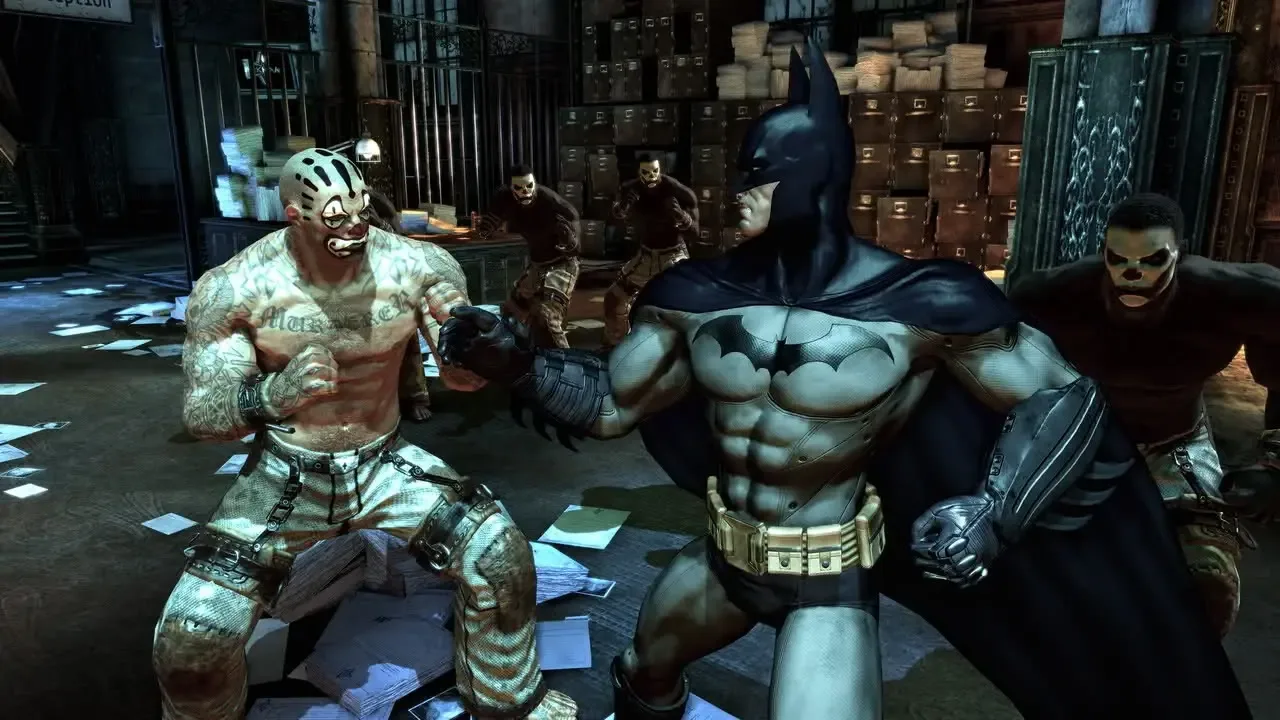
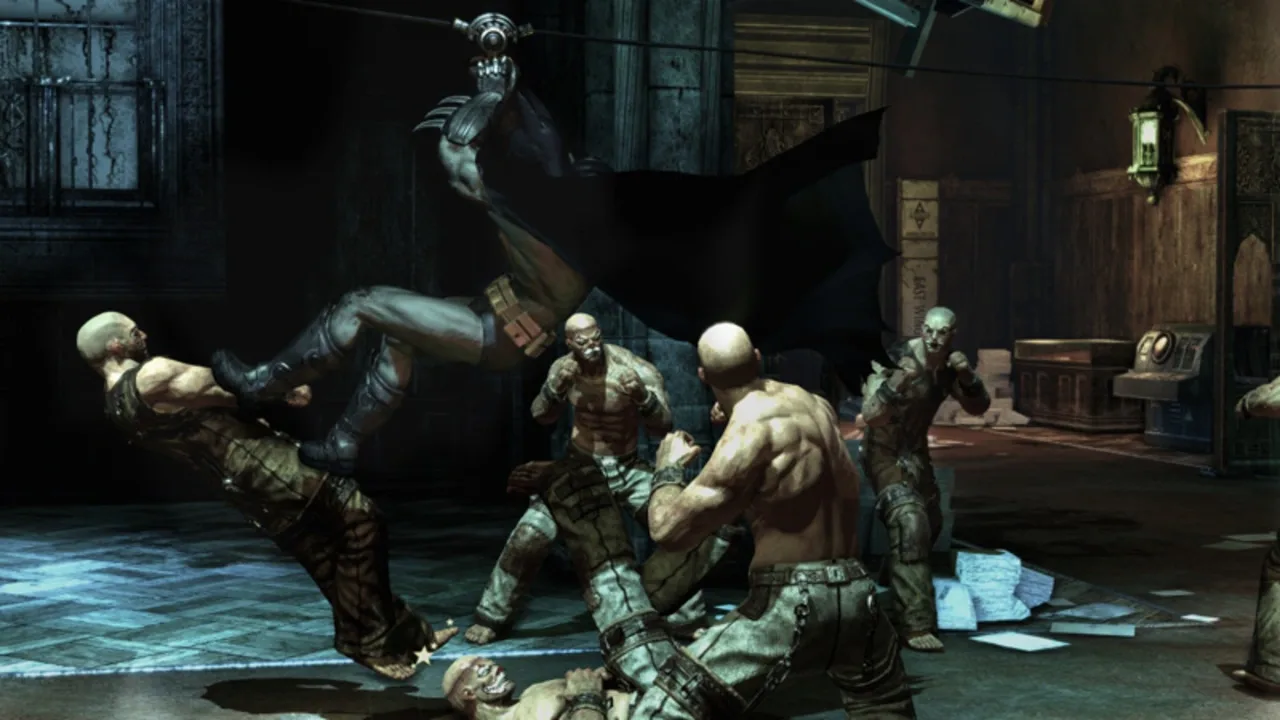
FreeFlow combat looks simple before its systems begin interacting. Batman attacks one enemy, counters another, vaults over a third, throws a Batarang, and keeps the sequence moving as long as the player maintains awareness. There are relatively few basic commands compared with a traditional fighting game, but the challenge comes from choosing the right action without allowing the rhythm to collapse.
That distinction helped Arkham Asylum avoid making Batman feel like an ordinary brawler. He automatically closes distance between nearby enemies, allowing fights to move across entire rooms instead of forming small circles around a single opponent. Counter indicators communicate incoming attacks clearly, while enemies carrying knives, stun batons, or firearms gradually prevent the same attack-counter pattern from solving every encounter.
Later Arkham games made this system considerably more complicated. Returning to the original consequently exposes how limited its enemy combinations can be. Once the timing becomes familiar, ordinary groups offer less resistance than their numbers suggest. The smaller move set also means fewer ways to recover when repetition sets in.
The foundation remains excellent because every animation communicates momentum. Batman does not stand still exchanging punches. He moves between targets, knocks enemies down, redirects attacks, and transforms a crowd into something the player reads several actions ahead. Seventeen years of imitators have made the structure familiar. They have not made it ineffective.
Guns turn Batman from fighter into predator
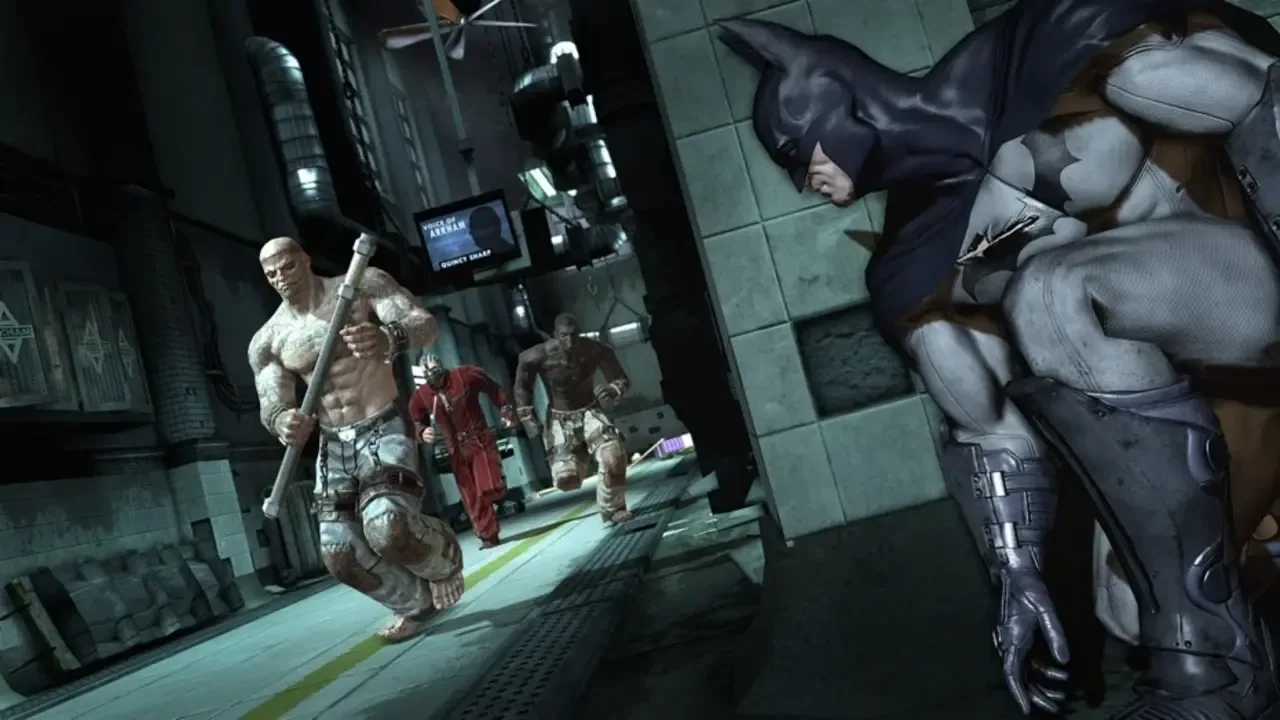
The sharpest design decision in Arkham Asylum is what happens when firearms enter a room. Batman can dominate twenty unarmed inmates but can die quickly if he tries the same approach against several armed guards. Strength stops being the answer.
Predator encounters move the action above the floor. Gargoyles provide observation points, floor grates create hidden routes, explosive gel can prepare traps, and isolated enemies become opportunities for silent or inverted takedowns. Detective Mode reveals positions through walls and shows how frightened remaining enemies have become. Remove one guard without being seen and the others begin behaving differently. Remove several and organized patrols turn into nervous men pointing weapons toward every noise.
That psychological element gives the stealth more personality than simply avoiding cones of vision. Batman is not hiding because he lacks the tools to fight. He is deliberately creating uncertainty.
Detective Mode is also one of the game's most obvious aging problems. It provides so much useful information that leaving it active becomes difficult to resist. Enemy locations, structural weaknesses, and interactive objects are immediately readable, but the blue visual filter obscures environments that deserve to be seen normally. A tool designed to make Batman perceptive can accidentally encourage players to spend large portions of Arkham looking through an interface rather than at Arkham itself.
The underlying predator rooms remain superb. Their relatively small size is an advantage. Each area behaves like a stealth puzzle where removing one enemy changes the conditions for everyone left behind.
Arkham Island is stronger because it has boundaries
Later games expanded toward an open Gotham, but Arkham Asylum benefits enormously from being trapped behind the same gates as its villains.
The island is divided into medical facilities, cell blocks, botanical gardens, caves, administrative spaces, and outdoor routes that gradually reconnect as Batman acquires additional equipment. The Cryptographic Sequencer opens electronic security systems. Explosive Gel breaks weakened structures. The Batclaw creates new opportunities for traversal and combat. Returning to an earlier building can reveal a ventilation shaft, destructible wall, or Riddler challenge that was inaccessible the first time through.
It creates a light Metroidvania structure without turning progression into a checklist. New gadgets matter because they change Batman's relationship with existing spaces, not merely because they increase a percentage on a statistics screen.
The Riddler challenges fit that philosophy particularly well. Some are trophies hidden behind traversal puzzles, while others ask players to interpret a cryptic clue and identify an object connected to Batman lore. Character biographies, interview tapes, and references to villains who never physically appear make the asylum feel connected to a much larger Gotham without requiring Rocksteady to build that city.
There is some backtracking, and navigating older interiors can become cumbersome when the objective requires crossing several familiar rooms. Yet the confinement gives Arkham Asylum something its sequels inevitably sacrifice: almost every location feels connected to the same bad night.
The villains are better before they become boss fights
Arkham is packed with recognizable Batman antagonists, but Rocksteady often uses them more effectively as threats surrounding combat than as opponents inside it.
Scarecrow provides the clearest example. His fear toxin transforms the asylum into surreal sequences where architecture breaks apart and Batman's perception becomes unreliable. They interrupt the established rules without simply increasing enemy health, and one famous sequence deliberately manipulates the presentation of the game itself. Scarecrow works because fighting him is secondary to experiencing what he does to Batman.
Killer Croc is similarly more effective as an environmental threat. Batman has to move through Croc's territory while minimizing noise, turning a physically powerful villain into something closer to a horror encounter.
Traditional bosses are much weaker. Bane establishes a pattern of avoiding charges and exploiting openings that later Titan enemies repeat. Poison Ivy relies on predictable attack cycles. The final confrontation with Joker is particularly disappointing because the character whose intelligence and unpredictability drive the entire night ultimately becomes another oversized physical opponent.
Time has not improved those encounters. If anything, their limitations stand out more clearly now because later action games became much better at using bosses to test systems learned throughout a campaign. Arkham Asylum builds memorable villains, then too often gives them ordinary videogame boss mechanics.
The atmosphere has aged better than the character models
Arkham Island remains an unpleasant place in exactly the right way. Gothic architecture collides with institutional corridors, rusted machinery, filthy treatment rooms, improvised Joker decorations, and sections reclaimed by vegetation. The environment changes as the night progresses, making the consequences of Joker's takeover increasingly visible.
Kevin Conroy and Mark Hamill remain central to why the story works. Batman is controlled and severe without becoming emotionless, while Joker spends much of the game communicating over screens and loudspeakers, making his presence unavoidable even when he is nowhere nearby. Harley Quinn, Scarecrow, Poison Ivy, and the surrounding inmate recordings give the setting enough personality that Arkham functions as more than a collection of themed levels.
Some visual elements show their age more clearly. Facial animation and civilian character models can look stiff next to modern productions, while repeated body types among inmates make crowds less convincing. Those technical limitations matter less than the art direction surrounding them.
The game is also straightforward to revisit today. The Game of the Year Edition remains available on PC, while console players can access Arkham Asylum through 2016's Batman: Return to Arkham, which remastered both Asylum and Arkham City and included their additional content. The remaster changes parts of the visual presentation, but neither version fundamentally alters the design that matters here.

Seventeen years later, Arkham Asylum still feels complete
Batman: Arkham Asylum has been surpassed mechanically by its own sequels. Arkham City gives FreeFlow combat more options, expands predator encounters, and provides a much larger playground. That does not automatically make the original obsolete. Its restrictions are part of its identity.
Rocksteady built one location, filled it with interconnected routes, and constantly changed what Batman was required to do inside it. Combat makes him physically dominant. Armed enemies force him toward stealth. Gadgets turn old spaces into new routes. Detective Mode makes information another weapon. The story then locks almost every major character inside the same increasingly unstable institution.
The boss fights remain the weakest part, Detective Mode is too useful for its own good, and enemy variety eventually begins repeating itself. Seventeen years after its August 25, 2009 debut, those limitations are easy to identify. They are also remarkably small compared with everything Arkham Asylum established. This is not merely an important superhero game that deserves respect because later developers copied it. It remains a tightly designed action game worth playing now, and still one of the clearest explanations of why being Batman can support far more than punching criminals.
The Verdict
Seventeen years later, Batman: Arkham Asylum remains one of the strongest superhero games because its combat, stealth, exploration, and atmosphere all serve the same Batman fantasy. Some boss fights and visual elements have aged, but the focused structure of Arkham Island still gives the game an identity that even its larger sequels could not completely replace.
The Good
- +FreeFlow combat still feels fast, readable, and rewarding
- +Predator encounters make Batman feel powerful without removing danger
- +Arkham Island is tightly connected and rewarding to explore
- +Strong atmosphere, voice acting, and villain encounters still hold up
The Bad
- -Boss fights are simplistic compared with the rest of the game
- -Detective Mode is so useful that it can discourage normal exploration

Batman: Arkham Asylum is an action-adventure game developed by Rocksteady Studios and published by Warner Bros. Interactive Entertainment. Released in 2009, it follows Batman as he battles the Joker, who seizes control of Arkham Asylum and frees its inmates. The game features ste
Released
August 25, 2009
Developer
Rocksteady Studios
Publisher
Eidos Interactive


Tagged In
Discussion
0We want to hear from you. Share your perspective in the comments below, and please keep the conversation respectful.
Log in to join the discussion - vote, reply, and share your take.
Log In