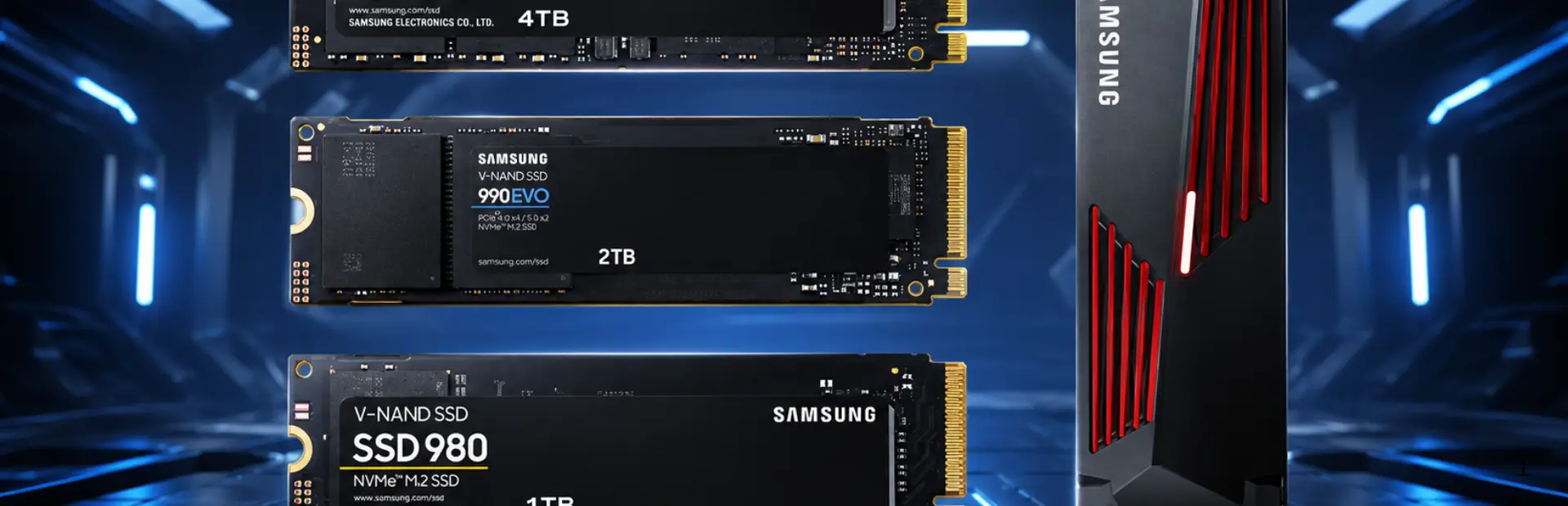
Credit: Samsung
featureFeature
The Hidden Cost of AI: Gamers Are Paying the Price
July 6, 2026·Updated September 14, 2026·6 min read
AI's demand for memory chips is driving up PS5 prices and AAA game budgets, leaving gamers stuck paying the real cost of the AI boom.
Artificial intelligence has a price tag. Not in some metaphorical sense, but in very real money that gamers are paying for consoles and games. While data centers buy up an ever larger share of the world's RAM and NAND production, the PlayStation 5 has doubled in price over the course of a year, AAA game budgets have crossed 300 million dollars, and an 80 dollar price tag for a game has stopped being the exception.
Artificial intelligence opens up enormous possibilities in many areas of entertainment, including game production. But it's worth remembering that this isn't an interest free loan. Here's how AI's massive popularity has translated into rising prices for consoles, components, and games.
How AI's Popularity Is Reshaping the Global Electronics Market
Artificial intelligence doesn't live in the cloud for free. It demands financial outlays. Every language model, every chatbot query, every training run of a new AI version requires physical hardware, and specifically enormous amounts of memory. Companies building data centers doubled their capital expenditures between 2024 and 2026, and current demand for silicon is now twice the world's production capacity. It's a bit like a situation where one very rich customer suddenly shows up, ready to buy up the entire flour supply for the next six months. Everyone else, meaning the smaller buyers, has to either get in line or pay a lot more for what's left.
The memory market is essentially controlled by three companies: Samsung, SK Hynix, and Micron. Memory makers give priority to large orders from corporate and cloud clients rather than focusing on the consumer market, simply because HBM memory built for AI servers generates higher margins than an ordinary RAM module for a laptop or console. Micron went even further and announced it's exiting its consumer brand Crucial, explaining the move as necessary to support bigger, strategic clients.
Memory Prices Are Up by as Much as 700%
The numbers are striking. Memory prices could rise by as much as 40-50% in the third quarter of 2026, and no improvement is expected before 2028. Over four years, prices have climbed by as much as 700%, largely because data center demand simply outstrips the combined production capacity of the three giants. Contract prices for DDR5 modules alone rose by more than 90% in the first quarter of 2026, and a memory kit that cost around 100 dollars in the fall of 2025 now starts at 350 dollars.
It's estimated that in 2026, data centers, both conventional and AI-dedicated, will consume more than 70% of global memory production. For the average gamer, that means a component you used to buy without thinking twice has become a scarce good.
Why Consoles Keep Costing More
The effects of this chain have reached straight to the store shelves where consoles sit. In April 2026, Sony announced yet another price increase for the PlayStation 5. The base PS5 model went up by 100 dollars in the US, and the PS5 Pro by as much as 150 dollars, edging it close to the 900 dollar mark.
Sony said in a blog post that they know price changes affect their community, and that after careful evaluation, they found this was a necessary step to keep delivering innovative, high quality gaming experiences to players around the world.
This flips a pattern gamers have gotten used to over decades. Historically, hardware got cheaper over time, because production costs fell as the technology matured. This time the console keeps getting more expensive long after launch, because the cost of its most important component is rising instead of falling. The effect shows up in the sales figures too, since after the March price hike, PS5 sales in Japan and the US dropped by as much as 30% year over year. The market reacted the way a shopper does when they suddenly see a higher price tag on a familiar product – some of them just walk away. The situation looks no different for Nintendo and Microsoft. Nintendo investors, worried about margin pressure from more expensive components, caused the company to lose 14 billion dollars in market value within just a few days.
AI Is Driving Up the Cost of Making Games
Pricier chips are only one side of the coin. The other is the games themselves, whose production budgets stopped resembling anything from a decade ago long ago. Today's AAA games made in the US and Canada now have budgets starting at 300 million dollars. That's nearly four times the average cost of a flagship game from the PlayStation 3 era.
The reason isn't executive salaries, it's simply the scale of these projects. Modern AAA games are made by hundreds, sometimes thousands, of people, and the production process takes several years. On top of that comes the chase for photorealism, ever larger open worlds, and increasingly elaborate motion capture technology. With a budget in the range of 300 million dollars, a game needs to sell at least six million copies just to break even. It's a bit like building a bridge that has to handle traffic for an entire city just to pay for itself, because building at a smaller scale simply doesn't pay off anymore.
The effect shows up on the shelf. Microsoft raised prices on its biggest productions from 70 to 80 dollars, and Nintendo sells its flagship titles in a similar range. Take-Two has also set the price of the upcoming GTA VI at 80 dollars for the base version.

Who Really Pays for AI Development? Gamers, at the End of the Chain
Chips go to data centers, because that's where they generate higher margins. Console makers pay more for memory, so they raise hardware prices. Game publishers pay more for teams, engines, and infrastructure, so they raise game prices. Unfortunately, standing at the very end of this food chain is the gamer.
This isn't a temporary turbulence that the market will correct on its own within a few months. Price pressure on memory is expected to persist at least until the end of2026, if the pace of data center investment doesn't slow down, and some forecasts point as far out as 2028. As long as training the next AI model matters more to business than selling a console or a graphics card, gamers will stay right where they are now: at the back of the line for resources that someone else can always afford to outbid them on.
Tagged In
AiGames Market
Discussion
0We want to hear from you. Share your perspective in the comments below, and please keep the conversation respectful.
Log in to join the discussion - vote, reply, and share your take.
Log In