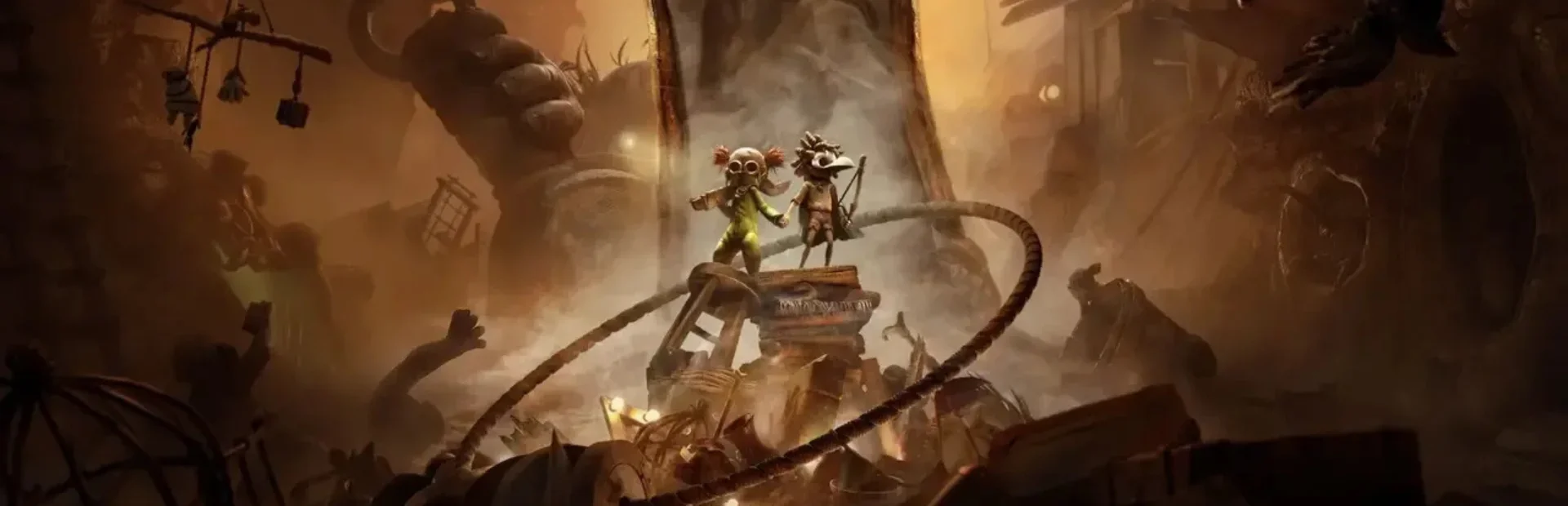
Credit: Supermassive Games
reviewlittle-nightmares-iii-1
Little Nightmares III is eerie, familiar, and too afraid to change
June 3, 2026·Updated September 16, 2026·6 min read
Little Nightmares III still knows how to make a room feel wrong. A giant toy, a warped factory, a dead city, a corridor that seems too quiet, a child-sized path through a place built for something much larger. The series’ visual language is still strong enough that I often wanted to keep moving just to see what horrible little stage it would build next.
But this is also the safest the series has felt. Supermassive Games understands the shape of Little Nightmares, maybe too well. Little Nightmares III has the silence, the tiny protagonists, the grotesque adults, the awkward jumps, the chase sequences, and the wordless unease. What it lacks is the shock of discovery. It feels like a careful continuation rather than a step forward, and the new co-op idea never becomes the evolution it should have been.
Low and Alone make co-op feel natural at first
Low and Alone are a smart pairing on paper. One carries a bow. The other carries a wrench. That split gives the game an easy way to build puzzles around cooperation, whether I am playing with another person or relying on the AI companion. It also gives the journey a softer emotional shape. These children are not just lost alone in a nightmare. They are lost together.
That changes the mood of the game. Earlier entries worked by making the player feel small and isolated. Little Nightmares III loses some of that loneliness, but it gains a quieter sense of dependency. Waiting for the other character, pulling each other through danger, and solving small problems together gives the adventure a different texture.
The issue is that the co-op rarely goes far enough. Too many interactions feel like simple tool checks: shoot this, hit that, climb here, help there. The game needed more moments where two players felt trapped inside the same panic. Instead, the partnership often feels neat, readable, and underused.
The world still looks beautifully awful
The strongest part of Little Nightmares III is still its art direction. The Spiral gives the game a string of unsettling places to move through, each built around scale, decay, and childish fear twisted into something ugly. The Necropolis, the candy factory, and later locations all have images that stick in the mind, even when the gameplay around them stays familiar.
This is a game that understands the horror of being small. Tables become walls. Toys become threats. Food becomes disgusting. Ordinary rooms turn into stages where the player feels like an intruder. I liked how often the game made me pause before entering a new space, not because I expected a jump scare, but because the room itself looked hostile.
There are limits, though. The first two games had monsters that felt instantly iconic. Little Nightmares III has striking designs, but fewer that carry the same force. Some threats feel like variations on a known formula rather than new nightmares. The craft is clear, but the surprise is weaker.
The scares are more atmospheric than frightening
Little Nightmares III is more eerie than scary. That is not automatically a problem. The series has never been pure horror in the loudest sense. Its best moments come from dread, scale, silence, and the discomfort of being hunted by something that should not move the way it does.
There are still good chases here. The camera pulls back, the music tightens, and suddenly the smallness of Low and Alone becomes terrifying again. Those moments work when the game keeps the objective clear and lets panic do the rest. Running through a collapsing space or escaping a huge creature still has that old series tension.
But the fear fades faster this time. Part of that comes from familiarity. I know how Little Nightmares builds a scene now. I know when a chase is coming, when a puzzle room is waiting, and when a grotesque figure is about to become the center of the chapter. The game is good at mood, but it rarely makes me feel unsafe in a new way.
The puzzles are clean but rarely memorable
The puzzles are simple, readable, and usually paced well enough to keep the adventure moving. Most of them involve positioning, timing, the two character tools, or finding a way through oversized spaces. I rarely got stuck for long, and I appreciated that the game did not break its mood with overly fussy logic problems.
That simplicity also holds it back. Too many puzzles feel like small interruptions rather than ideas with their own tension. Use the bow, swing the wrench, move the object, climb through, repeat. The game gives Low and Alone different roles, but it does not build enough complex scenarios around that difference.
The platforming has the same familiar problem the series has carried for years. Depth can be difficult to read, and a missed jump can feel less like my mistake than the game’s perspective betraying me. It is not constant enough to ruin the experience, but it is still annoying that the third main entry has not fully solved such an old frustration.
The best chapters show what the sequel could have been
There are stretches where Little Nightmares III becomes the sequel I wanted. The stronger chapters combine a clearer visual identity with better pacing, sharper threats, and a more interesting use of space. When that happens, the game stops feeling like a respectful imitation and starts to feel alive on its own.
Those moments usually come when the level design gives me more than a straight haunted corridor. A room that asks me to look twice, a sequence that uses light or space in a stranger way, or a chase that bends the environment around the two characters can still make the game exciting. The series’ formula has not run out of power. It just needs to be pushed harder.
That is what makes the safer chapters frustrating. Little Nightmares III clearly has the talent and visual control to create memorable horror. It just spends too much of its runtime staying inside the lines. I wanted more risk, more strange mechanics, and more moments where co-op changed the emotional shape of the nightmare.
Little Nightmares III is worth playing, but it feels too careful
Little Nightmares III is not a bad sequel. It looks excellent, has several strong scenes, and still delivers the eerie puzzle-platform horror the series is known for. Players who mainly want another short trip through a beautifully rotten world will find enough to enjoy, especially with a co-op partner.
But it is hard to shake the feeling that this should have been more. The co-op is underused, the scares feel familiar, and the best images do not always lead to the best play. I would recommend Little Nightmares III to fans who already love the series’ mood and can accept a safe continuation. Anyone hoping for a bold new nightmare may leave disappointed.
Discussion
0We want to hear from you. Share your perspective in the comments below, and please keep the conversation respectful.
Log in to join the discussion - vote, reply, and share your take.
Log In