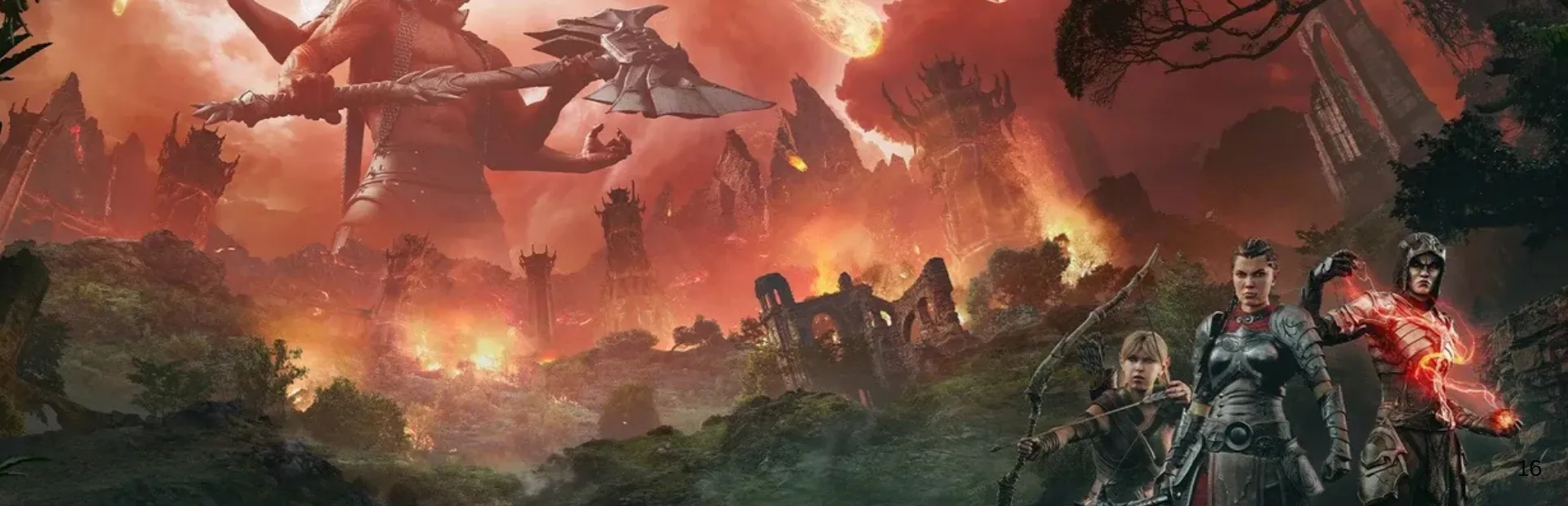
Credit: ZeniMax Online Studios
featureFeature
Microsoft Wants Forever Games, But the ESO Layoffs Show the Real Cost
July 9, 2026·Updated September 15, 2026·5 min read
Microsoft wants lasting live-service games, but ESO layoffs at ZeniMax Online show the cost when content, events and community teams are cut.
Every major publisher wants a game players keep returning to for years: regular updates, paid extras, subscriptions and a community that stays active long after launch.
The Elder Scrolls Online already became that game. After a rough 2014 launch, ESO rebuilt its reputation and grew into a long-running MMO with a loyal audience. At GDC 2024, studio director Matt Firor said the game had made nearly $2 billion over its lifetime.
Microsoft's latest cuts are hard to square with that success. Xbox wants durable franchises and steady revenue, yet the first posts from inside ZeniMax Online Studios suggested that the layoffs had reached ESO's content pipeline. Senior content designer Katherine Souza posted on Bluesky that half of her team had been laid off.
A live-service game depends on those teams. If they shrink too far, the "forever game" starts to look a lot less permanent.
Microsoft Cut Into ESO's Content and Community Engine
The cuts did not land far away from ESO's day-to-day game. Senior content designer Katherine Souza clarified that her earlier "half the team" wording referred to active developers working on content, events and dungeons, not the entire ZeniMax Online Studios workforce.
Those are still important parts of an MMO: the teams closest to the repeatable content players see between larger releases.
The senior names make the impact clearer. Associate design director Mike Finnigan was among those affected after nearly 15 years at ZeniMax Online. He said he had worked across dungeons, arenas, trials, events, zones and challenge difficulty. Senior community engagement manager Gina Bruno was also let go after almost 19 years at the studio.
Bruno's exit was perhaps the hardest pill to swallow for the ESO community, as she was the one directly shaping their relationship with the game.
The official ESO team said Season One remains the immediate focus, but also told players that previously shared roadmaps beyond Season One "will be shifting" while the studio evaluates the work ahead and prepares an updated schedule.
So the concern is not that ESO suddenly stops working. The factual concern is narrower and stronger: Microsoft has cut into the people tied to content, events, dungeons and community communication at the same moment the official roadmap is being revised.

ESO Plus Is a Bet on Tomorrow
An MMO subscription is never only about the current patch. ESO Plus players pay for convenience, access and value today, but the real deal is longer than that. They keep investing in builds, guilds, houses and characters because Tamriel is supposed to keep moving.
Heavy cuts put that relationship under pressure. A smaller content team means less room for new events, quick fixes, fresh rewards and steady dungeon work. Systems can slip. Bugs can wait another patch. The game may still function, but the pace starts to change, and pace matters in an MMO. It is part of what players pay for.
The danger is the loop that live-service communities know too well. Content slows down, active players drift, revenue becomes harder to defend and the next round of cuts becomes easier to justify. Nobody needs to declare the game dead for the mood to shift. Players simply stop assuming the next big reason to return is guaranteed.
ESO is not dead. That would be a lazy claim. The more realistic fear is quieter: the game stays online, but starts to feel thinner.
The Spreadsheet Finally Reached the MMO
Microsoft's reasoning is easy to read, even if the result feels messy. Xbox is in the middle of a major restructuring, with roughly 3,200 roles expected to go through FY27 and several studios moving outside Microsoft's direct control. In reported internal memos, Xbox leadership also pointed to weaker margins than comparable platform and publishing businesses, after bets on Game Pass, multi-platform releases and a larger content portfolio failed to grow at the pace Microsoft wanted.
That explains the pressure behind the cuts. ESO still makes the decision harder to defend.
A live-service MMO should be exactly the kind of asset Microsoft wants: recurring spend, a long-running community, steady content and a world that can keep earning years after launch. ESO reached that point the hard way. It survived a bad launch, rebuilt player trust and turned into one of the few MMOs with real staying power.
Then the cost-cutting reached the people maintaining it.
Microsoft wants fewer risky bets and more durable revenue. ESO already offered that. Cutting into the teams that keep the game active does not look like discipline around a weak project. It looks like Microsoft trimming the machinery that made the project valuable in the first place.

Servers Run on Code. MMOs Run on People
ZeniMax and Microsoft can still say the expected things. ESO remains online, Season One is still planned and the team can still be committed to the game. Key people leaving does not mean Tamriel shuts down overnight.
But keeping the servers running is only part of maintaining a decade-old MMO.
ESO also depends on people who know the game in detail: dungeon designers who understand its combat rhythm, event teams who know the calendar, QA testers who remember where older systems tend to break and community managers who know which concerns keep coming back from players.
Microsoft says it wants games that last for years. ESO already reached that point. The tragedy is that Xbox has chosen to protect its most durable live-service engine by removing the very parts that kept it running.
Every legend starts somewhere and in The Elder Scrolls Online, it starts with you. Write your story into a vibrant chapter of Tamriel’s distant past that takes place nearly 1,000 years before the iconic TES V: Skyrim, and discover a world steeped in adventure and possibility.
rpg
Released
April 4, 2014
Developer
ZeniMax Online Studios
Publisher
Bethesda Softworks
Systems


Tagged In
Elder Scrolls OnlineXboxZenimax Online
Discussion
0We want to hear from you. Share your perspective in the comments below, and please keep the conversation respectful.
Log in to join the discussion - vote, reply, and share your take.
Log In